App 06
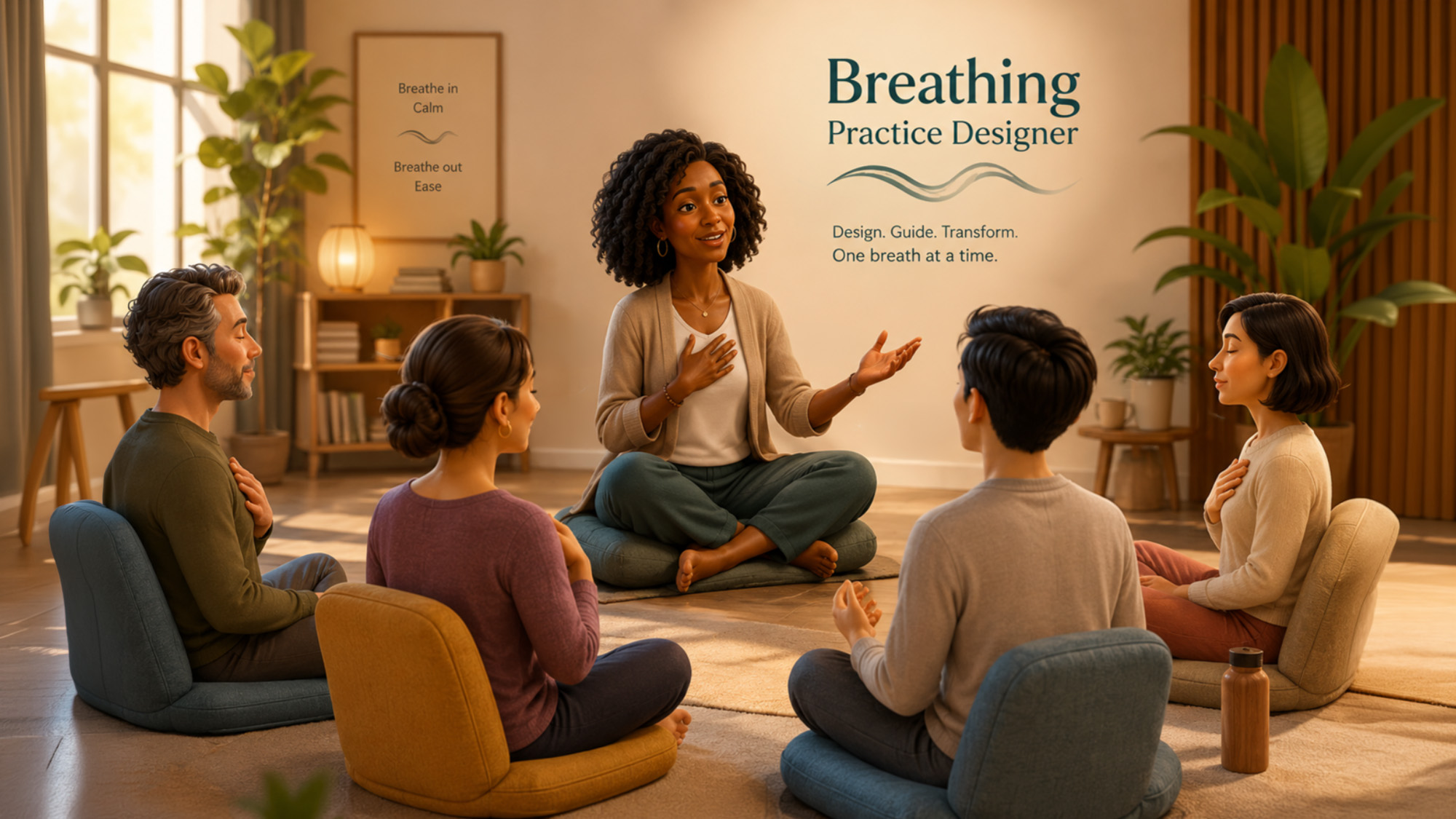
Breathing Practice Designer
Create gentle breath-based practices.
Mode 1
Help.
Help Mode Menu
Tell me about
the breathing practice
you would like to create.
Things to think about: What kind of breathing practice? For example: breath awareness, calming breath, grounding breath, breath counting, extended exhale, box breathing, coherent breathing or a short reset practice. How long? For example: 1, 3, 5, 10, 15 or 20 minutes. Who is it for? For example: beginners, a workplace group, a one-to-one client, an online group, an experienced class, children, teenagers, carers or older adults. What is the main theme? For example: settling, grounding, focus, calming, transition, preparing for sleep, emotional balance or returning to the present. What tone would you like? For example: gentle, simple, secular, warm, spacious, practical, professional or beginner-friendly. Anything I should be careful about? For example: anxiety, asthma or breathing difficulty, trauma-sensitive language, no breath retention, low energy, pregnancy, pain, limited mobility, online delivery or very little time.
Here is a sample prompt: “Please create a 5-minute gentle breathing practice for workplace beginners. Keep it secular and practical, avoid breath holding, and include an option to use the feet or sounds as an anchor instead of the breath.” Now...as you feel more confident...begin to type...
Things to think about: What kind of breathing practice? For example: breath awareness, calming breath, grounding breath, breath counting, extended exhale, box breathing, coherent breathing or a short reset practice. How long? For example: 1, 3, 5, 10, 15 or 20 minutes. Who is it for? For example: beginners, a workplace group, a one-to-one client, an online group, an experienced class, children, teenagers, carers or older adults. What is the main theme? For example: settling, grounding, focus, calming, transition, preparing for sleep, emotional balance or returning to the present. What tone would you like? For example: gentle, simple, secular, warm, spacious, practical, professional or beginner-friendly. Anything I should be careful about? For example: anxiety, asthma or breathing difficulty, trauma-sensitive language, no breath retention, low energy, pregnancy, pain, limited mobility, online delivery or very little time.
Here is a sample prompt: “Please create a 5-minute gentle breathing practice for workplace beginners. Keep it secular and practical, avoid breath holding, and include an option to use the feet or sounds as an anchor instead of the breath.” Now...as you feel more confident...begin to type...
Mode 2
Coach.
Coach Mode Menu
I can help you think
through how to design a
gentle breathing practice.
Things to think about: The intention What you want the practice to support, such as settling, grounding, focus, calming, transition, rest or returning to the present. The type of breathing practice Whether breath awareness, breath counting, extended exhale, box breathing, coherent breathing, natural breathing or a simple reset practice would fit best. The audience Who the practice is for, and what they may need. The level of effort How active or passive the breathing practice should be. The pacing How much guidance, silence, repetition and space to include. The language How to make the wording warm, clear, invitational, simple, secular, practical or professional. Safety and care Anything to consider around anxiety, asthma or breathing difficulty, pregnancy, pain, limited mobility, breath sensitivity, no breath retention or emotional sensitivity. Alternative anchors How to offer choices such as feet on the floor, contact with the chair, sounds in the room, hands resting on the body or visual grounding. The ending How to help people return, orient and integrate the practice.
Remember...You can ask anything related to coaching.
Things to think about: The intention What you want the practice to support, such as settling, grounding, focus, calming, transition, rest or returning to the present. The type of breathing practice Whether breath awareness, breath counting, extended exhale, box breathing, coherent breathing, natural breathing or a simple reset practice would fit best. The audience Who the practice is for, and what they may need. The level of effort How active or passive the breathing practice should be. The pacing How much guidance, silence, repetition and space to include. The language How to make the wording warm, clear, invitational, simple, secular, practical or professional. Safety and care Anything to consider around anxiety, asthma or breathing difficulty, pregnancy, pain, limited mobility, breath sensitivity, no breath retention or emotional sensitivity. Alternative anchors How to offer choices such as feet on the floor, contact with the chair, sounds in the room, hands resting on the body or visual grounding. The ending How to help people return, orient and integrate the practice.
Remember...You can ask anything related to coaching.
Mode 3
Science.
Science Mode Menu
I can explain
the science behind
gentle breathing practices
in clear, practical language.
You might like to know: Breath awareness Why the breath can be a useful anchor for attention, and why it should not be forced. Natural breathing Why simply noticing the breath may be more suitable than trying to control it. Extended exhale Why a longer out-breath may feel settling for some people, while still needing to be offered gently. Breath counting How counting can give the mind a simple structure without making the practice too complicated. Box breathing Why structured breathing can support focus, and why it may not suit everyone. Coherent breathing Why steady, even breathing may feel calming for some people, without presenting it as a treatment. Alternative anchors Why feet, chair contact, hands, sounds or visual grounding can be helpful when breath focus is uncomfortable. Pacing and effort Why breathing practices should usually be introduced slowly, gently and without pressure. Safety and care Why choice, comfort, no forced breath, no unnecessary breath holding and the use of invitational language are especially important.
Remember...You can ask me anything about science and scientific principles.
You might like to know: Breath awareness Why the breath can be a useful anchor for attention, and why it should not be forced. Natural breathing Why simply noticing the breath may be more suitable than trying to control it. Extended exhale Why a longer out-breath may feel settling for some people, while still needing to be offered gently. Breath counting How counting can give the mind a simple structure without making the practice too complicated. Box breathing Why structured breathing can support focus, and why it may not suit everyone. Coherent breathing Why steady, even breathing may feel calming for some people, without presenting it as a treatment. Alternative anchors Why feet, chair contact, hands, sounds or visual grounding can be helpful when breath focus is uncomfortable. Pacing and effort Why breathing practices should usually be introduced slowly, gently and without pressure. Safety and care Why choice, comfort, no forced breath, no unnecessary breath holding and the use of invitational language are especially important.
Remember...You can ask me anything about science and scientific principles.
Mode 4
Storytelling.
Stories Mode Menu
I can show you short teaching stories
about skilful use of breathing practices
in real mindfulness teaching situations.
You might want a story about: A beginner group finding breath focus difficult How a teacher normalises the experience and offers another anchor. A workplace group needing a short reset How a teacher keeps the breathing practice simple, secular and practical. A person becoming uncomfortable with the breath How a teacher offers choice without drawing attention to them. A teacher avoiding forced breathing How gentle awareness works better than pushing people to breathe in a certain way. A group arriving stressed or distracted How a teacher uses grounding before introducing breath awareness. An online breathing practice How a teacher gives clearer choices, shorter instructions and visible options. A breathing practice that felt too technical How a teacher simplifies the language and reduces the counting. A teacher adapting box breathing How a teacher makes a structured practice softer, optional and beginner-safe. A group needing alternatives to breath focus How a teacher offers feet, chair contact, sounds or hands as anchors. A teacher learning to use more space How fewer instructions allow people to experience the breath more naturally.
You can choose one of these, or ask for a story about any breathing practice situation you are facing. I’ll tell a short story and draw out the teaching lesson.
You might want a story about: A beginner group finding breath focus difficult How a teacher normalises the experience and offers another anchor. A workplace group needing a short reset How a teacher keeps the breathing practice simple, secular and practical. A person becoming uncomfortable with the breath How a teacher offers choice without drawing attention to them. A teacher avoiding forced breathing How gentle awareness works better than pushing people to breathe in a certain way. A group arriving stressed or distracted How a teacher uses grounding before introducing breath awareness. An online breathing practice How a teacher gives clearer choices, shorter instructions and visible options. A breathing practice that felt too technical How a teacher simplifies the language and reduces the counting. A teacher adapting box breathing How a teacher makes a structured practice softer, optional and beginner-safe. A group needing alternatives to breath focus How a teacher offers feet, chair contact, sounds or hands as anchors. A teacher learning to use more space How fewer instructions allow people to experience the breath more naturally.
You can choose one of these, or ask for a story about any breathing practice situation you are facing. I’ll tell a short story and draw out the teaching lesson.