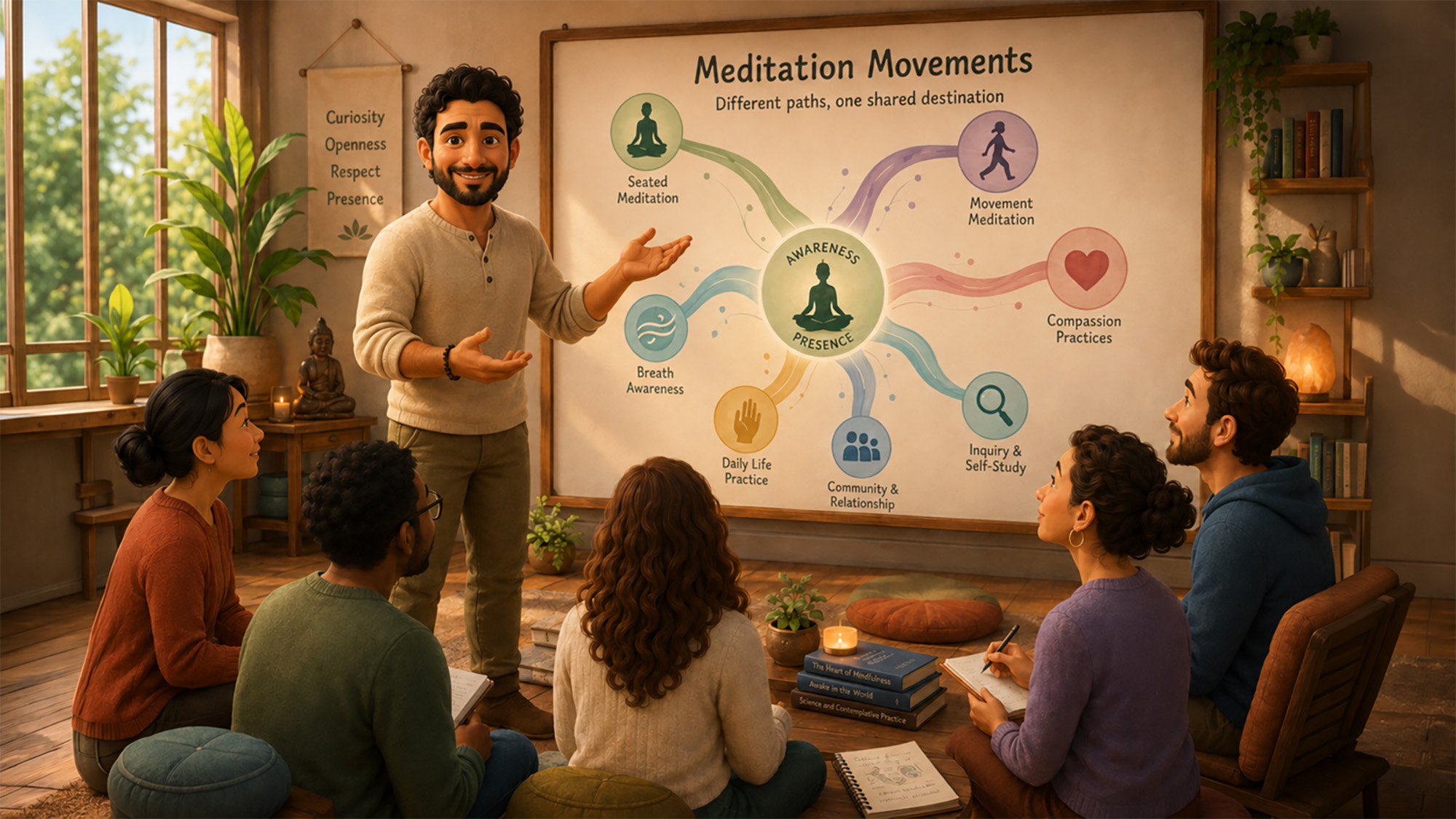
Mode 1
Help.
Help Mode Menu
Tell me about the
meditation movement,
method or teacher you
would like to explore.
Things to think about: What would you like to explore? For example: secular mindfulness, Transcendental Meditation, HeartMath, Wim Hof Method, Joe Dispenza-style meditation, Sam Harris, Tara Brach, Jack Kornfield, breathwork movements, biohacking meditation, compassion-based approaches, non-dual meditation or performance meditation. What kind of talk would you like? For example: an introduction, a balanced overview, a comparison, a teacher-training talk, a strengths-and-limits overview, or a talk about how it overlaps with mindfulness. Who is the talk for? For example: trainee mindfulness teachers, experienced teachers, workplace facilitators, students, a general audience or your own learning. What should the talk focus on? For example: key ideas, methods, teaching style, evidence, claims, similarities to mindfulness, differences from mindfulness, risks, cautions, or practical teaching relevance. What tone would you like? For example: clear, warm, secular, respectful, balanced, evidence-aware, practical, curious, teacher-friendly or academic-light. Anything I should be careful about? For example: avoid promotion, avoid being dismissive, avoid overclaiming, distinguish evidence from claims, respect traditions, keep it suitable for professional teachers, or be careful with healing and transformation claims.
Here is a sample prompt: “Please create a 10-minute teacher-friendly talk on Joe Dispenza-style meditation. Explain how it overlaps with mindfulness, how it differs, what is interesting about the research, and what teachers should be careful not to overclaim.” Now...as you feel confident...you can begin to type...
Things to think about: What would you like to explore? For example: secular mindfulness, Transcendental Meditation, HeartMath, Wim Hof Method, Joe Dispenza-style meditation, Sam Harris, Tara Brach, Jack Kornfield, breathwork movements, biohacking meditation, compassion-based approaches, non-dual meditation or performance meditation. What kind of talk would you like? For example: an introduction, a balanced overview, a comparison, a teacher-training talk, a strengths-and-limits overview, or a talk about how it overlaps with mindfulness. Who is the talk for? For example: trainee mindfulness teachers, experienced teachers, workplace facilitators, students, a general audience or your own learning. What should the talk focus on? For example: key ideas, methods, teaching style, evidence, claims, similarities to mindfulness, differences from mindfulness, risks, cautions, or practical teaching relevance. What tone would you like? For example: clear, warm, secular, respectful, balanced, evidence-aware, practical, curious, teacher-friendly or academic-light. Anything I should be careful about? For example: avoid promotion, avoid being dismissive, avoid overclaiming, distinguish evidence from claims, respect traditions, keep it suitable for professional teachers, or be careful with healing and transformation claims.
Here is a sample prompt: “Please create a 10-minute teacher-friendly talk on Joe Dispenza-style meditation. Explain how it overlaps with mindfulness, how it differs, what is interesting about the research, and what teachers should be careful not to overclaim.” Now...as you feel confident...you can begin to type...
Mode 2
Coach.
Coach Mode Menu
I can help you think
through a modern meditation
movement, method or teacher in a
clear, balanced and practical way.
Things to think about: The movement or method What it teaches, how it works and why people are drawn to it. The overlap with mindfulness Where it connects with mindfulness through attention, awareness, breath, body, compassion, presence or meditation. The differences from mindfulness Where it differs in aim, method, language, claims, tradition, intensity, spirituality or commercial framing. The teaching style How the movement communicates, guides practice, uses authority, tells stories or frames transformation. The evidence What research may suggest, what is uncertain, what is anecdotal and what may be overstated. The claims How to evaluate claims about healing, performance, manifestation, brain states, nervous system change or altered consciousness. The audience Who may find the approach appealing, and who may need caution, adaptation or alternatives. The teaching relevance What mindfulness teachers might learn, borrow carefully, avoid or compare. The ethical questions How to think about authority, marketing, vulnerable audiences, spiritual claims, commercial claims and professional boundaries. The comparison How one movement differs from another, or how it differs from mainstream mindfulness.
Remember...You can ask anything related to coaching.
Things to think about: The movement or method What it teaches, how it works and why people are drawn to it. The overlap with mindfulness Where it connects with mindfulness through attention, awareness, breath, body, compassion, presence or meditation. The differences from mindfulness Where it differs in aim, method, language, claims, tradition, intensity, spirituality or commercial framing. The teaching style How the movement communicates, guides practice, uses authority, tells stories or frames transformation. The evidence What research may suggest, what is uncertain, what is anecdotal and what may be overstated. The claims How to evaluate claims about healing, performance, manifestation, brain states, nervous system change or altered consciousness. The audience Who may find the approach appealing, and who may need caution, adaptation or alternatives. The teaching relevance What mindfulness teachers might learn, borrow carefully, avoid or compare. The ethical questions How to think about authority, marketing, vulnerable audiences, spiritual claims, commercial claims and professional boundaries. The comparison How one movement differs from another, or how it differs from mainstream mindfulness.
Remember...You can ask anything related to coaching.
Mode 3
Science.
Science Mode Menu
I can explain the science behind
modern meditation movements and
methods in clear, practical language.
You might like to know: Attention and practice How many meditation movements train attention, awareness, concentration, imagination or intention in different ways. Emotion and state change Why many movements use emotion, meaning, music, imagery, breath or group energy to create strong experiences. Belief and expectation How expectation, framing and meaning can shape what people notice and experience. Breath and physiology Why breath-based movements may affect arousal, sensation and state, while needing careful safety language. Body and nervous system language How movements use ideas such as regulation, coherence, energy or embodiment, and why these need careful framing. Brain states and EEG Why alpha, theta, gamma, coherence and altered states are often used in meditation-movement claims. Group practice and social influence How shared practice, teacher authority, community and ritual can intensify experience and meaning. Transformation claims Why claims about healing, awakening, manifestation or identity change need careful evaluation. Research evidence How to distinguish peer-reviewed research, personal testimony, observational studies, marketing language and speculation. Overlap and difference Why a movement may share methods with mindfulness while having different aims, assumptions or claims.
Remember...You can ask me anything about science and scientific principles.
You might like to know: Attention and practice How many meditation movements train attention, awareness, concentration, imagination or intention in different ways. Emotion and state change Why many movements use emotion, meaning, music, imagery, breath or group energy to create strong experiences. Belief and expectation How expectation, framing and meaning can shape what people notice and experience. Breath and physiology Why breath-based movements may affect arousal, sensation and state, while needing careful safety language. Body and nervous system language How movements use ideas such as regulation, coherence, energy or embodiment, and why these need careful framing. Brain states and EEG Why alpha, theta, gamma, coherence and altered states are often used in meditation-movement claims. Group practice and social influence How shared practice, teacher authority, community and ritual can intensify experience and meaning. Transformation claims Why claims about healing, awakening, manifestation or identity change need careful evaluation. Research evidence How to distinguish peer-reviewed research, personal testimony, observational studies, marketing language and speculation. Overlap and difference Why a movement may share methods with mindfulness while having different aims, assumptions or claims.
Remember...You can ask me anything about science and scientific principles.
Mode 4
Storytelling.
Stories Mode Menu
I can show you short teaching stories about
teachers discussing meditation-adjacent movements
in a balanced, respectful and evidence-aware way.
You might want a story about: A teacher discussing Joe Dispenza-style meditation How the teacher explores state change and research interest without promoting healing claims. A teacher discussing Wim Hof Method How the teacher distinguishes breathwork and cold exposure from standard mindfulness practice. A teacher discussing HeartMath How the teacher talks about coherence carefully without making it sound like a guaranteed state. A teacher discussing Transcendental Meditation How the teacher compares mantra-based practice with mindfulness without dismissing either. A teacher discussing Sam Harris How the teacher explores secular, non-dual meditation while keeping language accessible. A teacher discussing biohacking meditation How the teacher keeps curiosity while avoiding performance-based pressure. A teacher responding to a question about manifestation How the teacher acknowledges belief, intention and emotion without making unsupported claims. A teacher comparing mindfulness and breathwork How the teacher explains overlap and difference with safety and clarity. A workplace group asking about meditation trends How the teacher gives a balanced answer without turning the session into a debate. A teacher avoiding polarisation How the teacher speaks respectfully about a controversial movement while still evaluating claims.
You can choose one of these, or ask for a story about any meditation movement, method or teacher you are exploring. I’ll tell a short story and draw out the teaching lesson.
You might want a story about: A teacher discussing Joe Dispenza-style meditation How the teacher explores state change and research interest without promoting healing claims. A teacher discussing Wim Hof Method How the teacher distinguishes breathwork and cold exposure from standard mindfulness practice. A teacher discussing HeartMath How the teacher talks about coherence carefully without making it sound like a guaranteed state. A teacher discussing Transcendental Meditation How the teacher compares mantra-based practice with mindfulness without dismissing either. A teacher discussing Sam Harris How the teacher explores secular, non-dual meditation while keeping language accessible. A teacher discussing biohacking meditation How the teacher keeps curiosity while avoiding performance-based pressure. A teacher responding to a question about manifestation How the teacher acknowledges belief, intention and emotion without making unsupported claims. A teacher comparing mindfulness and breathwork How the teacher explains overlap and difference with safety and clarity. A workplace group asking about meditation trends How the teacher gives a balanced answer without turning the session into a debate. A teacher avoiding polarisation How the teacher speaks respectfully about a controversial movement while still evaluating claims.
You can choose one of these, or ask for a story about any meditation movement, method or teacher you are exploring. I’ll tell a short story and draw out the teaching lesson.